

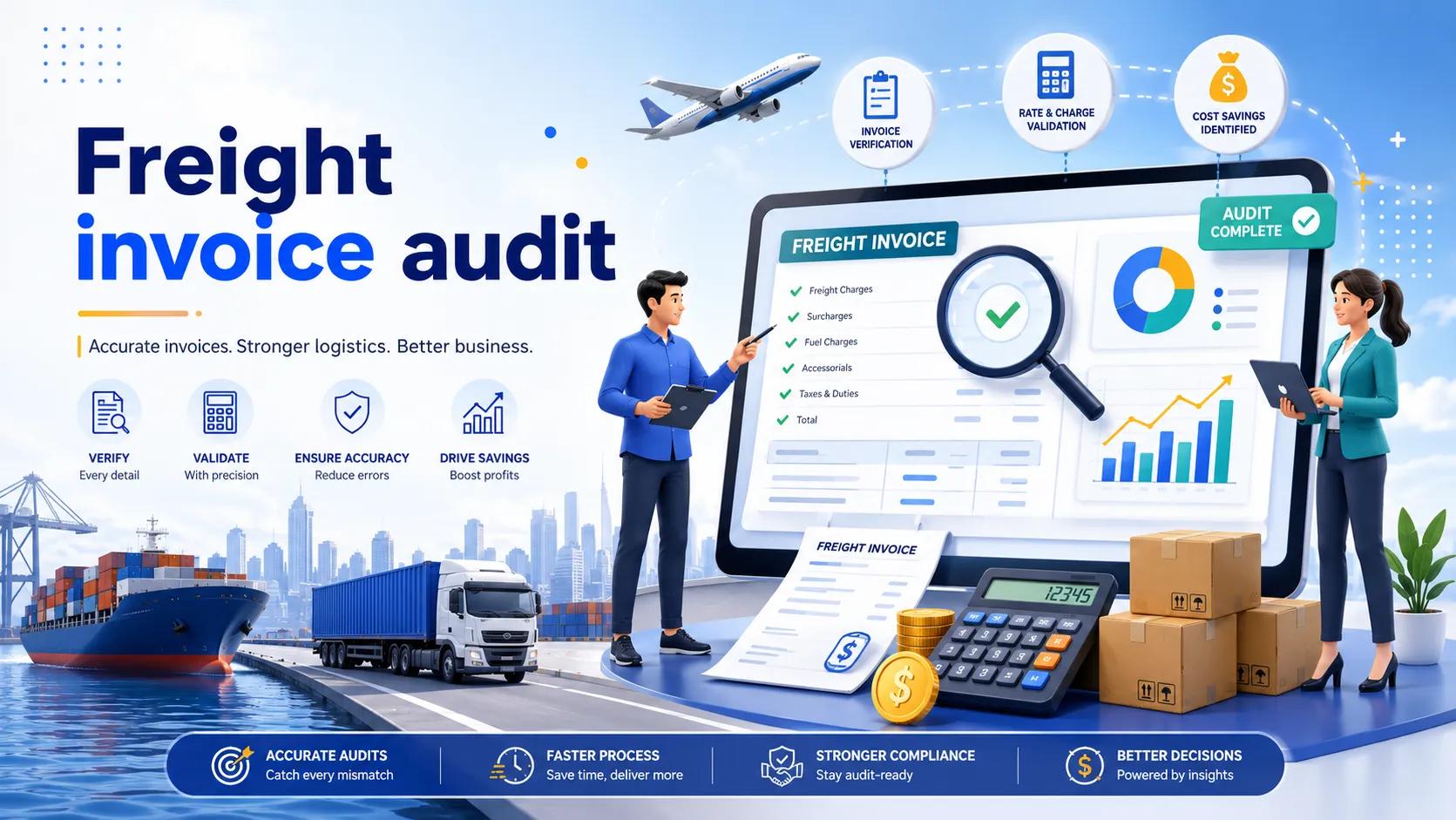
Every shipment your business moves generates a paper trail, and somewhere in that trail, money is quietly disappearing. A freight invoice audit is no longer just a back-office reconciliation task. In 2026, it has evolved into one of the most powerful levers companies pull to recover lost revenue, eliminate billing errors, and gain real competitive advantage in their supply chains.
Why Freight Billing Errors Are Getting Worse, Not Better
Carrier networks have grown more complex. Multi-modal shipments, fuel surcharge fluctuations, dimensional weight discrepancies, and accessorial charges have multiplied the number of line items on every invoice. The result is a billing environment where errors, both accidental and systematic, have become almost inevitable.
Studies across the logistics industry consistently show that a significant portion of freight invoices contain at least one error. These are not small discrepancies. Duplicate billings, incorrect rate applications, missed negotiated discounts, and misclassified freight all add up over time. Without a structured freight bill audit process, these costs silently erode your margins quarter after quarter.
The Shift From Cost Control to Revenue Recovery
Traditional thinking treated freight auditing as a cost-control measure. The goal was simple: catch the obvious errors before payment and avoid overpaying. That mindset, while still relevant, no longer captures the full value of what modern freight auditing services can deliver.
Today, a well-executed freight audit and payment process does something more ambitious. It creates a continuous feedback loop between your transportation spend data and your financial operations. Every audited invoice feeds intelligence back into carrier negotiations, contract compliance reviews, and budget forecasting. Companies that embrace this shift are not just avoiding losses. They are actively recovering revenue that has already been misallocated and using the data to prevent future leakage.
This is a fundamentally different proposition. You move from defense to offence.
What Modern Freight Audit Services Actually Cover
The scope of freight audit services in 2026 extends well beyond checking whether a carrier charged the right rate. A comprehensive audit program typically examines contract compliance against agreed tariffs and lane-specific pricing, accessorial charge validation including liftgate fees, residential delivery surcharges, and fuel adjustments, service failure credits where carriers missed guaranteed transit times, duplicate invoice detection across high-volume shipping accounts, and dimensional and weight verification against your own shipping records.
Each of these categories represents a real financial recovery opportunity. When you multiply even small per-shipment discrepancies across thousands of invoices annually, the figures become substantial very quickly.
The Role of Technology in 2026
Automation has fundamentally changed what is possible in freight auditing. Machine learning models now flag anomalies in real time, matching invoice data against rate databases, shipment records, and historical carrier behaviour patterns. Cloud-based platforms integrate directly with TMS and ERP systems, eliminating the manual data entry that once made auditing slow and resource-intensive.
This technology shift means companies of all sizes can now access enterprise-grade audit capabilities without building expensive in-house teams. Third-party freight auditing services powered by AI can process thousands of invoices daily, surface discrepancies within hours of receipt, and generate dispute documentation automatically.
The speed matters. Carrier dispute windows have deadlines. An audit that takes weeks to complete may recover nothing even when errors are clearly present.
Building an Audit Strategy That Scales
For businesses shipping at scale, the question is not whether to audit but how to build a programme that keeps pace with volume and complexity. The most effective approach combines automated pre-payment auditing to catch errors before funds leave your account, post-payment recovery audits to reclaim amounts already paid in error, and periodic contract audits to ensure carriers are honouring negotiated terms across all lanes.
Each layer addresses a different type of leakage, and together they form a complete financial control framework around your transportation spend.
Take Control of Your Freight Spend Today
If your business is processing freight invoices without a structured audit programme, you are almost certainly leaving money on the table every single month. The gap between what you are paying and what you should be paying is recoverable, but only if you act with the right tools and expertise behind you.
nVision Global specialises in end-to-end freight audit and payment solutions that help shippers around the world recover overcharges, enforce contract compliance, and transform their transportation data into a strategic asset. Connect with nVision Global today and find out exactly how much your supply chain has been leaving behind.